
‘Woke’ military academies targeted in new blueprint for sweeping warfighting overhaul
20 July 2026 2026-07-20 20:02‘Woke’ military academies targeted in new blueprint for sweeping warfighting overhaul
‘Woke’ military academies targeted in new blueprint for sweeping warfighting overhaul
Doug Truax, USMA ’92, is interviewed in this article and helped write the report.
By Morgan Phillips | Fox News
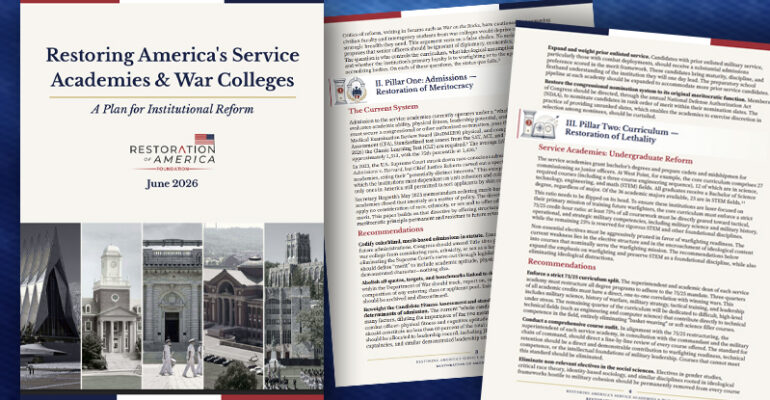
A conservative organization is calling for a sweeping overhaul of America’s service academies and war colleges, arguing the institutions have drifted too far toward civilian academia and urging Congress to permanently enshrine the Trump administration’s military education reforms into law.
The 12-page blueprint, obtained by Fox News Digital, was drafted by Restoration of America, a conservative advocacy organization that promotes right-leaning public policy proposals and political engagement and proposes reshaping admissions, curriculum, faculty and governance around a single objective of preparing officers to “win the nation’s wars” by returning military education to what its authors describe as a warfighting-first mission.
“The expectation is that they’re generating warfighters, not philosophers and future bureaucrats,” Restoration of America founder Doug Truax, a West Point graduate, told Fox News Digital.
“We pay a lot for these academies … and the expectation is that they’re generating warfighters.”
A Pentagon review already has led to changes at the academies. West Point disbanded a dozen cadet clubs centered on race, ethnicity, gender and sexual orientation to comply with the administration’s anti-diversity, equity and inclusion directives.
During a March 26, 2025, Senate Armed Services Committee hearing, the service academy superintendents testified that West Point had eliminated two elective courses — “Race, Ethnicity and Nation” and “Power and Difference” — while the Naval Academy canceled two courses, “Gender Matters” and “Gender Sexuality Studies,” and modified 18 others as part of a Pentagon-directed review of diversity-related curriculum.
But Truax argues those changes should not end with executive action.
“We have to take our opportunity when we have power to put this into law,” Truax said. “Otherwise, we’ll look back and be like, ‘Well, we had that one little moment where it was getting better, but now we’re right back where we were.'”
Truax said the foundation is sharing the blueprint with lawmakers and administration officials in hopes Congress will codify many of the recommendations through legislation.
He said executive orders can be reversed by future administrations, making statutory changes the only way to ensure the reforms endure.
The blueprint is organized around four pillars — admissions, curriculum, faculty and governance — and proposes some of the most sweeping changes to military education advanced by conservatives since President Donald Trump returned to office.
Among its recommendations, the paper calls for permanently banning consideration of race, ethnicity and sex in admissions decisions, requiring at least 75% of coursework to focus directly on military competencies and warfighting, replacing most civilian professors with active-duty or retired military officers and abolishing tenure at military educational institutions.
It also recommends ending academy participation in the Rhodes Scholarship program, arguing the military’s top young officers should spend their formative years leading troops rather than pursuing prestigious overseas academic fellowships, along with eliminating diversity, equity and inclusion offices and restructuring academy oversight boards.
Truax argued the nation’s military academies gradually adopted the culture and priorities of civilian universities during the Obama and Biden administrations, shifting attention away from preparing officers for combat.
Critics of similar proposals argue senior military education exists to prepare future generals and admirals for strategic leadership rather than tactical command.
In a March essay published by War on the Rocks, retired Army officer Bradford Duplessis argued “the cult of lethality approach, characterized by its focus on tactical warfighting at the expense of strategic study, will not produce senior military leaders with the necessary skills and attributes to effectively lead in today’s complex environment.
“The removal of civilian faculty from the war colleges would result in brain drain in vital areas where military officers possess little to no experience or education,” he added.
Duplessis argued senior officers “must understand the responsibilities of their future bosses” and said strategic leadership requires an understanding of diplomacy, politics and other instruments of national power in addition to military force.
Truax rejected that argument, saying he believes the officer corps has spent too much time learning to think like “politicians, State Department employees and military contractors” instead of warriors, a theme echoed throughout the blueprint.
While Truax praised War Secretary Pete Hegseth for taking what he called “a number of steps in the right direction,” he argued executive action alone is insufficient.
“There’s been a number of steps in the right direction,” Truax said. “However, here’s the main problem. A lot of this has been done by executive order.
“Woke did not go anywhere,” he added. “It’s just in hiding right now.”
Fox News Digital has reached out to the Department of War and all three military service academies for comment.
Restoring America’s Service Academies & War Colleges: A Plan for Institutional Reform (pdf)
Executive Summary
The primary purpose of the U.S. service academies and war colleges is to produce officers capable of winning the nation’s wars.
That purpose has been diluted by decades of institutional drift toward the norms, incentives, and ideological commitments of civilian academia.
The result is a professional military education system that churns out credentialed strategists rather than warfighters, rewarding the habits of the seminar room over the demands of the battlefield.
This white paper proposes a comprehensive reform agenda organized around four pillars: admissions, curriculum, faculty, and governance.
Each pillar is designed to restore a single animating principle to the center of military education: the relentless preparation of officers to close with and destroy the enemies of the United States.
The proposals herein build on the reform momentum initiated by President Donald Trump’s Executive Order 14173, titled “Ending Illegal Discrimination and Restoring Merit-Based Opportunity,” and Secretary of War Pete Hegseth’s subsequent directives banning race- and sex-based considerations from academy admissions and ordering a task force to evaluate the senior service colleges.
Some commentators have cautioned against what they term the “cult of lethality,” arguing that senior officers need strategic breadth, not more tactical training.
The strategic failures of the past twenty-five years were not caused by officers who understood warfighting too well; they were caused by an officer corps trained to think like diplomats and contractors rather than warriors willing to deliver blunt counsel to their civilian leaders.
The corrective is not more of the same education that produced those failures. It is a fundamental reorientation of every institution that shapes the American officer.
READ REPORT: Restoring America’s Service Academies & War Colleges: A Plan for Institutional Reform (pdf)
Related Posts




Thursday, Oct 22, 2026
Noon ET / 10:00 am MT via Zoom
Guest Speaker: LTC Robert Maginnis, USA ret, USMA ’73
More Info & Register






“Don’t Give Up the Ship” – Essays by the Calvert Task Group on woke policies endangering our military and nation:
